Battered fish with swede and carrot mash
A proper fish supper, with a root-vegetable mash standing in for chips and peas
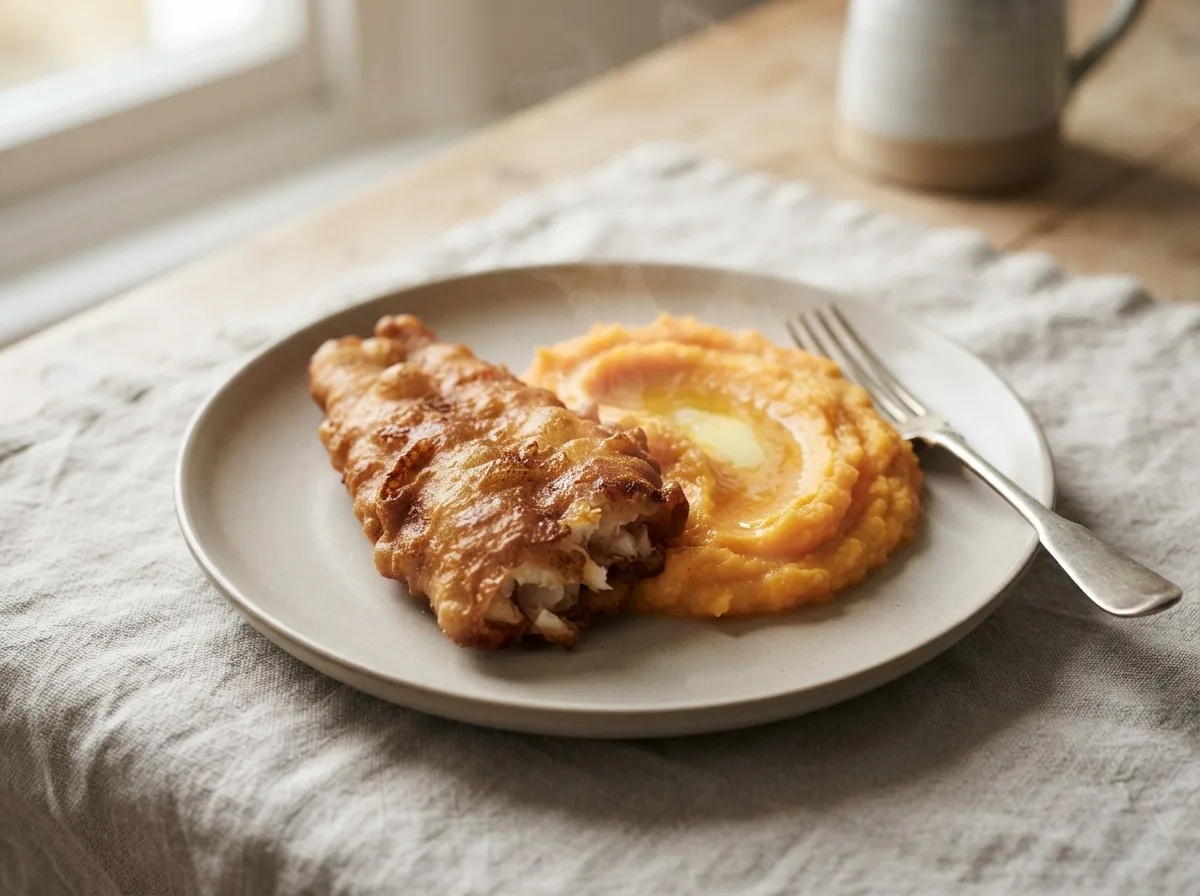
Doubles easily by using a larger pan for the mash and frying the fish in two batches so the pan is not crowded.
Fish and chips is the dish people ask about first, and there is no reason it has to disappear. The batter here is nothing more than flour, egg and milk whisked to the thickness of double cream, no beer and no fizzy water needed to get it light and golden. Mushy peas are the part that has to go, since a pea skin is exactly the kind of thing a narrowed gut cannot manage, so swede and carrot take their place, boiled soft and mashed with butter until they turn the same bright, sweet orange. Fry the fish in a shallow pool of oil, turning it once, so the batter sets into a proper golden crust rather than a soggy one. The fish needs almost no attention. The batter and the mash are where the care goes.
Ingredients
Contains: Gluten, Egg, Milk, Fish
- 150 gswede, peeled and cut into 1.5 cm chunks
- 150 gcarrot, peeled and cut into 2 cm chunks
- 20 gunsalted butter
- salt
- 75 gplain white flour, plus a little extra for dusting the fish
- 1egg, beaten
- 75 mlwhole milk
- 1white fish fillet, about 175 g, such as cod, haddock or pollock, skinless and boneless
- 150 mlvegetable oil, for shallow-frying
Method
Put the swede and carrot in a pan of cold water, bring to the boil and cook for 18 to 22 minutes, until both crush against the side of the pan with no resistance at all.
Drain well, then mash with the butter and a good pinch of salt until smooth. Push through a sieve for an even silkier result if you have the energy, and keep warm.
Swede is the slower of the two to break down, which is why it goes into the pan cut smaller than the carrot. Undercooked swede stays fibrous however hard you mash it.
Whisk the flour, a pinch of salt, the egg and the milk together in a bowl until you have a smooth, thick batter, about the consistency of double cream.
There is more batter here than one fillet needs, because you cannot dip a fillet in a puddle. It does not keep, so fry a second fillet if you have one.
Dust the fish fillet lightly in the extra flour, shaking off any excess, then lower it into the batter and turn to coat it completely.
Heat the oil in a small frying pan, about 20 cm across, over a medium-high heat until a drop of batter sizzles on contact. The oil should sit about 5 mm deep. Lower the fish in gently and fry for 3 to 4 minutes on each side, until the batter is deep golden and crisp and the fish flakes easily when pressed.
Lift onto kitchen paper for a moment to drain, then serve straight away on the mash.
Watch-points
- Peel the swede and carrot and boil them until a knife meets no resistance before mashing. Undercooked root vegetables leave fibrous strands behind.
- Coat the fish in a plain white-flour batter only. No beer, no fizzy water, no seeded coating.
- Shallow-fry in a few millimetres of oil in a small pan rather than deep-frying in quantity. Very fatty food sits heavily, and a light coating is the aim.
- Use a skinless, boneless white fish fillet and run a finger over it first to check for any stray bones.
Make it more nourishing
- Use 40 g of butter in the mash instead of 20, beaten in a little at a time so it stays glossy.
- Stir 2 tablespoons of double cream into the mash once it is off the heat, for about 120 kcal with no extra volume.
- Serve with a second fillet if appetite allows. Extra fish is the simplest way to add protein here.
Swaps
- Instead of swede and carrot, use 300 g of peeled potato, boiled and mashed with the butter
- closer to chips in spirit, and the plainest version if roots are not appealing
- Instead of white fish, use a skinless, boned salmon fillet, cut into one thick piece
- needs an extra minute or two in the pan but takes the batter equally well