Crème caramel
Sugar taken past the point that feels safe, and a custard baked low around it
plus at least 2 hours chilling, or overnight
Scales up to four ramekins in the same water bath if your roasting tin is large enough. It does not keep well past two days once turned out.
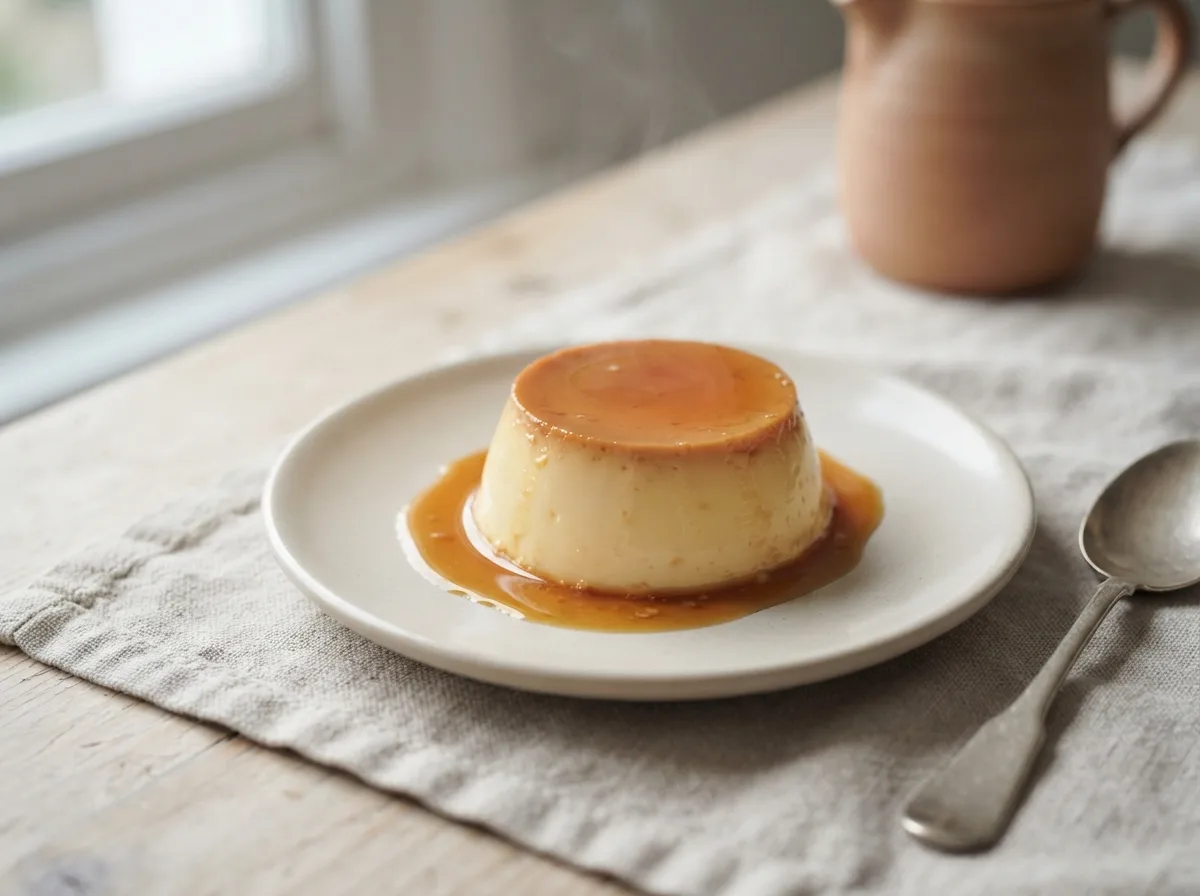
Crème caramel asks for exactly two skills, and neither is difficult once you have done it once. The first is watching sugar past the point it feels safe, until it turns the colour of strong tea and smells faintly of toffee rather than burnt matches. The second is keeping the custard below a simmer, in a water bath, so the egg sets slowly into something that holds a spoon rather than something that weeps. Get both right and the reward is disproportionate to the effort: a wobble that keeps its shape until the first cut releases a slick of dark caramel down the sides and onto the plate. It keeps well in the fridge for two days, which makes it a rare pudding you can finish long before anyone arrives to eat it.
Ingredients
Contains: Milk, Egg
- 130 ggolden caster sugar, 80 g for the caramel, 50 g for the custard
- 300 mlwhole milk
- 1 tspvanilla extract
- 2eggs
- 1egg yolk
Method
Put 80 g of the sugar in a small, pale-based pan with 2 tbsp of water. Heat gently until the sugar dissolves, without stirring, then turn up the heat and let it bubble hard until it turns a deep amber colour, swirling the pan rather than stirring it.
Stirring caramelising sugar tips it into crystals rather than a smooth amber liquid. Swirl the pan by its handle instead.
As soon as the caramel is deep amber, pour it straight into two 200 ml ramekins, tilting each one so it coats the base. Set aside to harden while you make the custard.
Heat the oven to 140°C fan (160°C). Warm the milk with the vanilla extract in a small pan until it is hot, with small bubbles forming at the edge, but not boiling.
In a bowl, whisk the 2 whole eggs, the egg yolk and the remaining 50 g of sugar together until combined, without beating in air.
Pour the hot milk onto the eggs in a thin stream, whisking gently as you go, then pass the mixture through a fine sieve into a jug so it is completely smooth.
Pour the custard over the set caramel in the ramekins. Stand them in a roasting tin, pour boiling water into the tin to come halfway up their sides, and bake for 35 to 40 minutes, until the custard is set at the edges with a gentle wobble at the centre.
Lift the ramekins from the water bath and leave to cool completely, then chill for at least 2 hours, or overnight for the cleanest turn-out.
To serve, run a thin knife around the edge of each ramekin, put a small plate on top and turn the whole thing over in one movement. The caramel runs down over the custard as it turns out.
If the caramel sticks to the ramekin, stand the base in a little hot water from the kettle for 20 seconds before turning out.
Watch-points
- Strain the custard through a fine sieve before it goes into the ramekins, so every last strand of egg white is caught and the set comes out completely smooth.
- Bake in a water bath at a gentle heat. A custard that boils separates and turns rubbery rather than silky.
- Chill the custard thoroughly, for at least two hours, before you try to turn it out. A warm one will not hold its shape.
- Keep it covered in the fridge and eat it within two days. Make that one day if you are having chemotherapy.
Some hospitals ask you to cut down on lactose during pelvic radiotherapy or after a low anterior resection; the leaflet this book follows sets no limit on milk. Use a lactose-free whole milk if you have been told to.
Make it more nourishing
- Use double cream in place of a third of the milk, about 100 ml, for a much richer set in the same volume.
- Stir 1 tbsp of skimmed milk powder into the milk before it warms. You will not taste it and it lifts the protein.
- Add an extra egg yolk to the custard for a silkier set and more protein, with no change to the method.
Swaps
- Instead of whole milk, use half whole milk, half single cream
- gives a firmer, richer set without changing the number of eggs
- Instead of golden caster sugar, use white caster sugar
- the caramel is a shade paler but behaves exactly the same way