Beef ragù with white tagliatelle
A slow sauce that freezes in neat portions
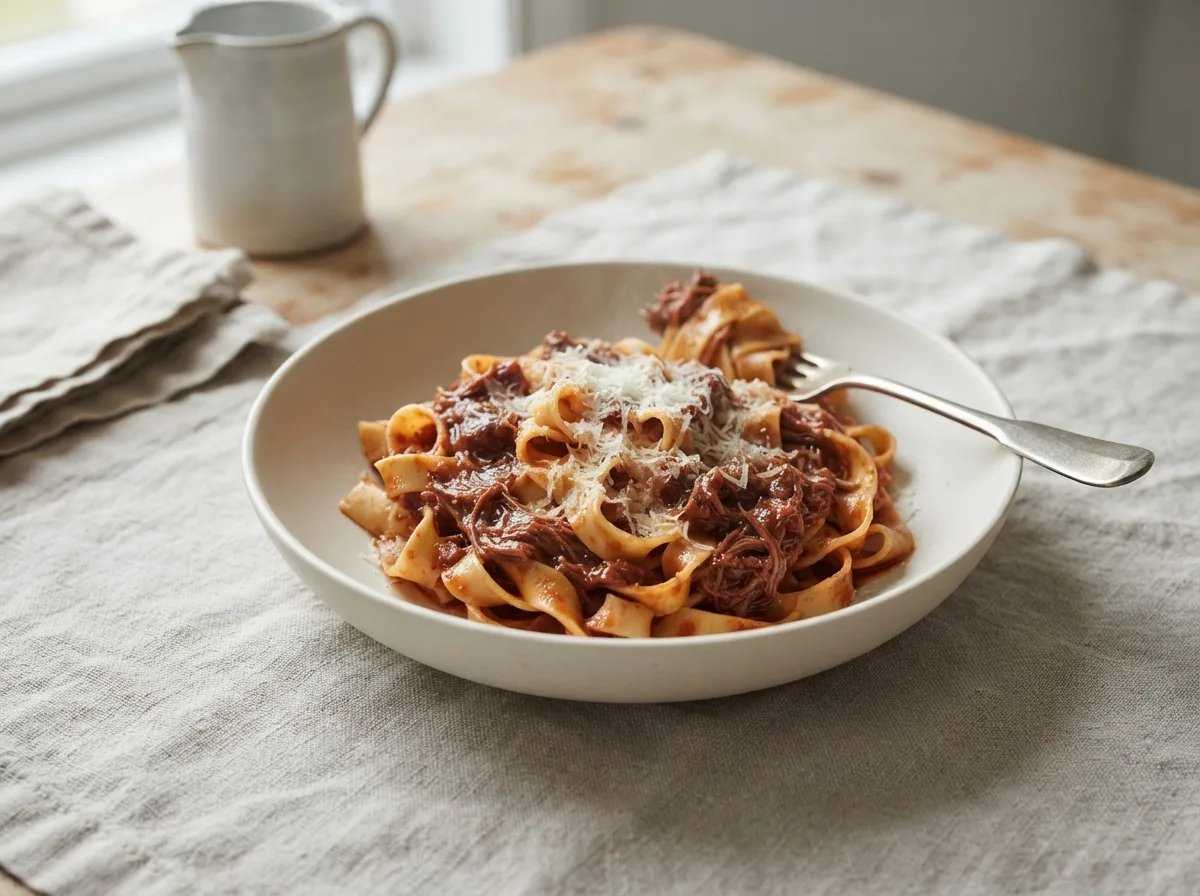
Doubles easily in a bigger pan and freezes in individual portions for up to three months.
Ragù is patience more than skill: grated onion cooked down until it disappears, carrot cut small enough that an hour and a half of simmering turns it to nothing you would notice, and a pan left mostly alone on the lowest heat while it does the work. No celery, which is where most ragù recipes start, because celery is exactly the stringy vegetable this diet cannot manage. What is left still tastes like the version you remember, because a long simmer and a good stock do more for flavour than a stick of celery ever did. Make a full batch on a day when you have the time. It keeps for three days in the fridge and freezes in flat, labelled bags that thaw in half an hour, so a proper dinner is never more than a defrost away.
Ingredients
Contains: Gluten, Milk, Celery
- 1onion, peeled and finely grated, cooked to melting into the sauceHospitals differ
Onion: Hospitals differ
Why the preparation matters. Cook it until completely soft, then either purée it into the sauce or strain it out. Never leave it crunchy or in strands.
Where hospitals differ. The leaflet this book follows lists "sausages with onions" as avoid and does not list onion itself as allowed. Several trusts allow well-cooked onion. This book uses onion only cooked to melting and then puréed or strained.
If your team says no. Leave the onion out and let the sauce taste of the meat, tomato and a scrape of Marmite instead.
Sources: East Lancashire Hospitals NHS Trust, Department of Nutrition & Dietetics, St George's University Hospitals NHS Foundation Trust
More about onion - 20 gunsalted butter
- 1carrot, peeled and cut into 5 mm dicePreparation matters
Carrot: Preparation matters
Why the preparation matters. Peel it and cook it until fully soft. Dice it small or mash it.
If your team says no. Leave it out. The ragu loses a little sweetness and colour, and nothing else.
Sources: East Lancashire Hospitals NHS Trust, Department of Nutrition & Dietetics
More about carrot - 350 gbeef mince, lean
- 400 mlpassata
- 200 mlclear beef stock, strained, or a good stock cubePreparation matters
Stock (chicken, beef, vegetable, dashi): Preparation matters
Why the preparation matters. Keep it clear and strained, with no vegetable pieces.
Sources: East Lancashire Hospitals NHS Trust, Department of Nutrition & Dietetics
More about stock (chicken, beef, vegetable, dashi) - salt
- 180 gtagliatelle, white, not wholewheat
- 30 gParmesan, finely grated, to serve
Method
Cook the grated onion gently in the butter in a large, heavy-based pan over a low heat for 10 minutes, stirring often, until it has completely melted down with no colour and no trace of a strand.
Stir in the carrot and cook for a further 5 minutes, until it starts to soften.
Turn the heat up to medium-high, add the beef mince and break it up with a wooden spoon. Cook for 8 minutes, stirring often, until it is evenly browned with no pink left.
Stir in the passata and the stock, and season with salt. Bring to a gentle simmer, then turn the heat right down, cover with the lid slightly ajar, and cook for 1 hour 15 minutes, stirring occasionally, until the carrot is completely soft and the sauce has thickened enough to coat the back of a spoon.
Give it longer rather than less if you can. Ragù only improves the longer it sits on a low heat.
About 12 minutes before the ragù is ready, bring a large pan of well-salted water to the boil and cook the tagliatelle for a minute longer than the packet says, until fully tender.
Drain the pasta, keeping a cupful of the cooking water, and toss it through the ragù with a splash of the water to loosen. Divide between two warm bowls and finish with the Parmesan.
Watch-points
- Grate the onion rather than chopping it, and cook it low and slow until it melts completely into the sauce with no strand left. Strands are what a narrowed bowel struggles with, not the onion itself.
- Dice the carrot small and give it the full simmering time, until a fork meets no resistance.
- Use a stock that is clear and strained, with no vegetable pieces floating in it.
- Leave celery out altogether, however classic it looks in other ragù recipes. It is one of the stringiest vegetables there is.
- Use white tagliatelle, not a wholewheat or spelt version.
Some hospitals allow onion left in visible pieces; the leaflet this book follows does not. Leave it out if you have been told to.
Stoma note: Onion, even cooked to melting, can still cause wind for some people. If that has been a problem for you before, leave it out and use an extra 100 ml of stock in its place.
Make it more nourishing
- Stir 20 g of butter into the finished ragù off the heat, just before serving.
- Use 400 g of mince rather than 350 for a denser sauce with more protein per bowl.
- Add a tablespoon of skimmed milk powder to the sauce as it simmers. You will not taste it and it lifts the protein.
Swaps
- Instead of beef mince, use lamb mince, or a mix of beef and pork
- any well-cooked mince behaves the same way in the sauce
- Instead of tagliatelle, use any white pasta shape, cooked soft
- the sauce does not depend on the shape
The foods in this recipe
Each of these has a page of its own, with how to prepare it and where hospitals differ.